Montag, 10. Januar 2011

Valparaiso

Valparaiso als eine der groessten Hafenstaedte von Chile hat uns sehr gut gefallen. Die Stadt erstreckt sich komplett auf ca. 40 Huegel und die Haeuser sind bunt angemalt. Das Haus von dem Literaturnobelpreistraeger Pablo Neruda konnten wir leider nicht anschauen, da es geschlossen war. Unser Hostel war im Viertel Bellavista gelegen, die Strassen und Hauswaende mit Mosaiken und Bildern bunt gestaltet. Von hier oben hatten wir auch einen wunderschoenen Blick ueber die Stadt, die Bucht und den Hafen. Auch die kleinen steilen Standseilbahnen haben wir ausprobiert.

------------------

Valparaíso is one of Chile's largest ports and it is famous for it colored houses placed neatly on the hillsides surrounding the bay. Furthermore, Valparaíso also features so called "ascensores" which are basically rail mounted cable cars that easily get you up and down the mountain.

We spent two days in Valp0 (as the locals call it) and wandered around the artist's quarters, enjoying the views and the sunshine before we finally left Valpo on a 17 hour bus ride to get to Patagonia.

Typcial Valparaíso houses


The container terminal

Ascensor de Artillerie

Pictures Santiago de Chile

Anbei noch ein paar Bilder aus Santiago.

Please find attached some more pictures from Santiago.


Mittwoch, 5. Januar 2011

Bariloche - Lake District

Finally Patagonia! We made it to Bariloche in Patagonia on a 17 hour busride through Chile and across the Andes. After some consulting with the local mountain club we changed our plan from hiking in the more northern Lanin National Park to a Lake Trek in the Nahuel Huapi National Park around Bariloche. So this evening we went out to get our supplies for the next 3-4 days. Tomorrow we will have a taxi set us off at an intersection in the middle of nowhere and we will trek 3 full days to our rendez-vous point at the other end of the lake where we hope to meet the bus again to take us back to Bariloche. We are really looking forward to a few peaceful days and are full of excitement for our upcoming trek - especially since the weather forecast is brilliant for the next days.

By the way,this is the area we will be hiking in.

We also feel a bit sorry that our blog is lacking some pictures lately but we haven´t run into any computers with usable USB ports. We hope to follow up on that after our trek. For now we have to go and prepare our backpacks! See you in 4 days!

---------------------

Geschafft, nach 17 Stunden Busfahrt und fast 2 Stunden an der chilenischen - argentinischen Grenze sind wir nun in Bariloche eingetroffen. Der Nachmittag war voll mit der Planung fuer die naechsten Tage. Wir fahren morgen mit dem Bus in die Berge um dort ca. 3 -4 Tage einen Trek um einen See zu absolvieren. Wir freuen uns schon darauf, da wir bereits heute aus dem Bus atemberaubende Landschaften und glasklares tuerkisfarbenes Wasser gesehen haben.

Anbei noch der Link zu der Region, in der wir die naechsten Tage wandern und zelten werden: Bariloche und Umgebung

Da wir in den letzten Tagen leider keinen Computer mit USB Schnittstelle finden konnten, fehlen leider noch ein paar Bilder der letzten Tage. Wir werden es so bald wie moeglich nachholen. Doch voraussichtlich werdet ihr erst in 4-5 Tagen wieder von uns hoeren. Wir hoffen, Euch geht es allen gut und ihr seid alle gut ins neue Jahr gekommen.

Sonntag, 2. Januar 2011

Rumble in Chile

Interestingly enough we found out through a text message from Germany that there had been an earthquake with 7.1 on the Richter scale. The quake was about 500 km south of Santiago so we didn't notice anything. No worries - we are fine, alive and kicking!

Tomorrow we are heading on to Valparaiso, a coast town 2 hours out of Santiago. Then we have a small route change. Instead of heading over the Andes into Patagonia, we will travel down Chile to Osorno (which is near the epicenter of the quake) and then cross over to Bariloche in Argentina. We will spend about 10 days in the Bariloche area finally hitting the backcountry for some trekking and camping.

We don't have a lot of pictures from Santiago because it was pretty hazy and it's yac (yet another city). Maybe a short note or impression we got from Chile so far: The landscapes are very interesting and the Andes Mountains impressive. The people, however, are not as friendly and polite as they were in Bolivia (of course there are also exceptions like e.g. our guide in San Pedro). The majority however, are quite rude - pushing ahead in lines, throwing trash into the countryside, acting arrogantly and most disturbing of all, bragging about how Chile stole land from Bolivia which now hosts some of the richest copper mines in the world. We must say, that we felt more at ease with the people in Bolivia, Peru and Ecuador.

---------------------------

Heute haben wir erst durch eine SMS aus Deutschland von dem Erdbeben der Stärke 7.1 auf der Richterskala erfahren, dass ca. 500 km südlich von Santiago stattgefunden hat. Wir haben hier überhaupt nichts gespürt und uns geht es sehr gut hier.

Morgen geht es für uns ca. 2 Stunden mit dem Bus nach Nordwesten von Santiago nach Valparaiso an den Pazifik. Nach einer Übernachtung geht es für uns dann ca. 1,5 Tage in den Süden über Osorno nach Bariloche, Argentinien. Hier freuen wir uns dann auch endlich auf unseren ersten Trek, Camping und eine tolle Seenlandschaft.

Heute ging es für uns auf den Cerro San Cristobal ... mit super vielen Chilenen, die ihren Sonntag mit einem Blick über Santiago geniessen wollten. Nach ca. 1h Wartezeit auf die Standseilbahn und einem sehr entspannten Spaziergang zum Aussichtspunkt und wieder abwärts ging es zu Fuss und mit der Metro zurück zum Hostal. Soeben haben wir noch richtig lecker Meeresfrüchte gegessen und geniessen einfach unseren Urlaub.

Samstag, 1. Januar 2011

Santiago de Chile

Und weiter ging es heute für uns in Richtung Süden. Mittlerweile sind wir auf ca. 33 Grad Süd, das heißt wir sind schon ca. 3663 km nach Süden gereist, seit unserer Zeit am Äquator Anfang November. 1 Stunde Busfahrt von San Pedro de Atacama nach Calama und ein Flug über Chile nach Süden mit einem Blick aus dem rechten Fenster auf den Pazifik und aus dem linken Fenster auf die Anden führten uns heute nach Santiago. Wir wohnen in einem richtig gemütlichen Hostel und geniessen einmal mehr unseren Urlaub. Da heute ja der 1. Januar ist, war nicht besonders viel los in der Stadt und so haben wir einfach nur ein sehr leckeres Essen im Fischrestaurant genossen.

Hier scheint die Sonne, es sind immer noch 27 Grad und wir merken, dass wir weiter im Süden sind, da um 20h30 die Sonne immer noch nicht ganz untergegangen war.

--------------------

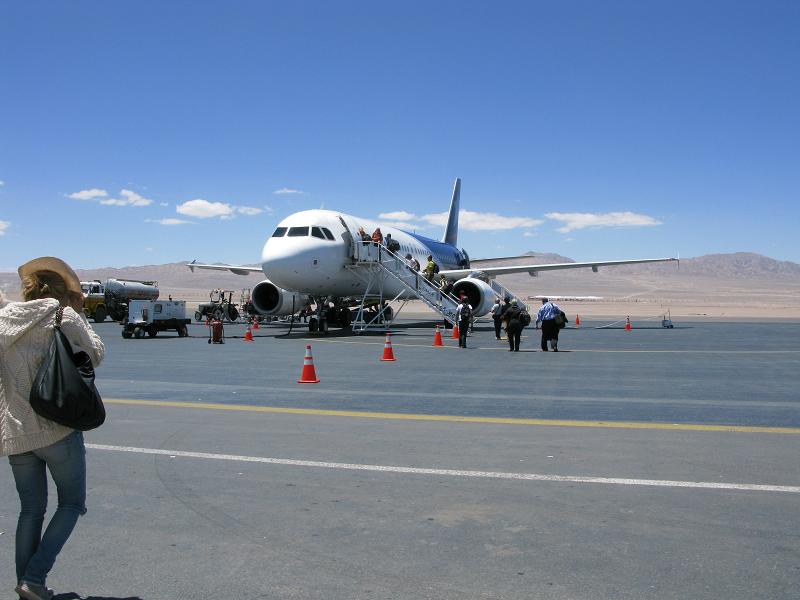
So on we go - SCL: Santiago de Chile is our current location. We had a nice flight with a great view of the Andean Mountains on the left hand side and the Pacific Ocean on the right hand side. Since the plane was very empty we both chose window seats on opposite sides of the plane so that we could see it all!

In SCL we are staying in a very nice hostel: Casa Roja - the perferct backpacker´s place run by Australians. We had a stroll through town in the evening, had a delicious seafood dinner and enjoyed daylight and 27°C at 20h30 in the evening.

We have meanwhile travelled 3.663 km south since Quito and are slowly starting to notice that the days are longer. We also descended in altitude. Our highest altitude was reached at the Sol de Manana Geysirs in Bolivia with a height of 4.900 mNN. After more then 4 weeks in altitudes of 3.000+ mNN we have now descended to 500 mNN and are clearly feeling the effects of an oxygen shock!


Our LANChile A320

San Pedro Salt Flats and Licancabur (left hand side)

More Volcanoes and Salt Flats


The Andean Mountains


Happy New Year

Nach einem wunderschönen und erlebnisreichen Sylvestertag möchten wir Euch noch alles Liebe und vor allem Gesundheit für das neue Jahr wünschen. Wir hoffen, ihr könnt alle Eure Pläne Wirklichkeit werden lassen und Grüssen Euch vom angeblich trockendsten Ort der Erde.

Am frühen Morgen ging es für uns mit dem Mountain Bike los in Richtung Norden von San Pedro de Atacama ins Death Valley. Eine atemberaubende, mehrere Millionen Jahre alte, durch Wind geformte Landschaft mit bizarren Formationen aus Salz und Lehm haben uns am Morgen begleitet. Weiter ging es durch das Tag des San Pedro River. Wir waren wirklich erstaunt, wieviel Wasser es doch in der Wüste geben kann. Dieses Wasser kommt aus den Bergen, wo es gerade auf der bolivianischen Seite doch häufiger regnet.

Nach einem gemütlichen Mittag in der Hängematte ging es für uns dann noch auf eine geführte Tour durch den noch nicht durch uns erkundeten Teil des Death Valley. Das Highlight war eindeutig der Abstieg über eine riesige Sanddüne! Weiter ging es ins Moon Valley, wo wir hören konnten, wie sich das Salz am Abend, wenn es kühler wird, zusammenzieht und "thermoplastische" Töne von sich gibt. Ein Knacken und Knarzen ... fast wie wenn man das Auto nach einer langen und heissen Fahrt abstellt und es sich abkühlt.

Das Jahr 2010 haben wir dann bei ziemlich heftigem Wind und einem traumhaften Sonnenuntergang mit einem tollen Farbenspiel auf den Anden beendet. Eine kleine Fiesta bei uns im Hostel hat dieses schöne Jahr 2010 für uns ganz gemütlich beendet. Es wurde sogar eine Strohpuppe verbrannt. Dies ist ein Brauch der Nordchilenen, um die alten Geister und schlechten Dinge des alten Jahres zu verbrennen und die neuen Dinge und Wünsche zu begrüssen.

In diesem Sinne wünschen wir Euch alles Liebe und viele tolle Erlebnisse für 2011.

Eure Katrin & Marcus


-----------------------


2011 is here - Happy New Year to all our blog readers. We hope you had a good party and wish you all the best for 2011.


We celebrated New Year´s Eve by indulging in tons of activities. Early in the morning we set off with a pair of mountain bikes to discover the Atacama Desert a bit - and only tourists would cycle in to the Valle de la Muerte (Death Valley). It was a very nice bike ride in fresh, crisp morning air and we enjoyed every bit of it.


In the afternoon we joined a group to visit the Valle de la Luna (Moon Valley) and the Valle de la Muerte from the other side. We had a very cool and knowledgable guide who showed and explained many things to us. The most impressive part was to see that we were walking in the Salt Mountain Range. The Salt Mountain range has its name from the fact that it is completely made of salt - and it is 8ookm long. Just as a comparison: The Black Forest is 140km long.


An interesting effect can be observed in the Salt Mountain Range - Thermoplasticity. During the day the mountains heat up and expand. Once the sun sets, the mountains cool down and contract again, making cracking noises. Very, very eerie.


The fun part was running down a sand dune which is about 300m high. We ended the day with a New Year´s party at our hostel and with packing our backpacks for the flight to Santiago de Chile - our next stop.


Katrin biking the Valle de la Muerte

Valle de la Muerte from above

On the sand dune

Sunset in the Valle de la Luna

Leaving the Atacama Desert for Santiago de Chile

Space Observation

Nach einem sehr guten Abendessen ging es fuer uns los zum Erkunden des abendlichen Sternenhimmels mit einem Experten. Leider war die Tour etwas chaotisch, da sich ausgerechnet heute eine Riesenwolke ueber der Atacama-Wüste breit gemacht hat. Wie wir von Alain Maury erfahren haben, gab es seit August nur 3x Wolken inklusive unserem Tag. Trotz alle dem haben wir Glück und die Wolke verzieht sich nach 1 Stunde und wir bekommen einen tollen Blick auf den Sternenhimmel, den Magellanschen Wolken, das Kreuz des Südens usw.

Wir müssen allerdings zugeben, dass uns der Himmel über dem bolivianischen Altiplano etwas mehr beeindruckt hat. Wie wir jedoch erfahren mussten, war dies nur der Fall, weil wir sehr gut aklimatisiert waren und unser Körper genügend Sauerstoff produziert hat. Würde Alain diese Touren in Bolivien anbieten und die Leute nur für 2 Stunden auf diese Höhe fahren, dann würden sie nicht viel sehen, weil quasi der Sauerstoff fehlt. Da es in Bolivien zu viele Tage mit Wolken und Niederschlag gibt, bleibt Alain mit seinem Observatorium in der Atacama-Wüste. Hier sind die Bedingungen zum Sternebeobachten normalerweise am Besten.

Wir haben auch nochmal erklärt bekommen, um welche Achse sich der Sternenhimmel wo auf dieser Welt dreht. So ist sehr schön klar geworden, warum der Sternenhimmel im Norden anders ist als im Süden. Wusstet ihr, dass man am Äquator den kompletten Himmel im Laufe eines Jahres sehen kann? Es fehlen "nur" die Sterne, die genau im Norden bzw. Süden liegen. Dies hatte man uns bereits in Ecuador erklärt, doch jetzt haben wir es nochmal bestätigt bekommen.

------------------------

So we are off to the Space Night with Alain Maury, a French astronomer who operates a star gazing lodge in the Atacama Desert with 9 telescopes. The evening startet out a bit chaotic since we had managed to hit the only 3rd day since August 2010 with a cloud in the sky. And exactly this one single cloud decided to move right over the telescopes. So the plan was changed to some Q&As to start off with. We could have asked Alain questions after questions all night long since it is really interesting to talk to an astronomer. However, the sky did clear, so we had to cut off the Q&A session and go back to the telescopes.

We observed Jupiter, many stars, the Magellan Clouds, Nebulaes and the remains of a Supernova. Furthermore, Alain explained certain constellations using a really cool green laser with which he could pinpoint at stars. Also the earth`s rotation and the effects of the rotation on the night sky were explained. Now it is completely clear to us why one can see the entire night sky throughout the year at the Equator but only parts of it on the Northern or Southern Hemisphere. Despite the lone cloud it was a great evening.